

Qwil Messenger in 2026: Integrations, New Markets and Product Development

Qwil Messenger is a Regolith portfolio company developing a secure client communication platform for financial services, wealth management, and healthcare.
From March through September 2026, the company focused on expanding integrations, growing its presence in Canada and the U.S. healthcare market, and enterprise sales. Qwil has also continued to develop the product itself, adding AI features, calendar functionality, new document tools, and a more streamlined onboarding process for new organizations. The company remains a relatively small private business led by its founder and CEO.
From Secure Messaging to an Integrated Client Platform
Qwil started as a secure communications solution for companies and their clients, but the platform has expanded significantly over time.
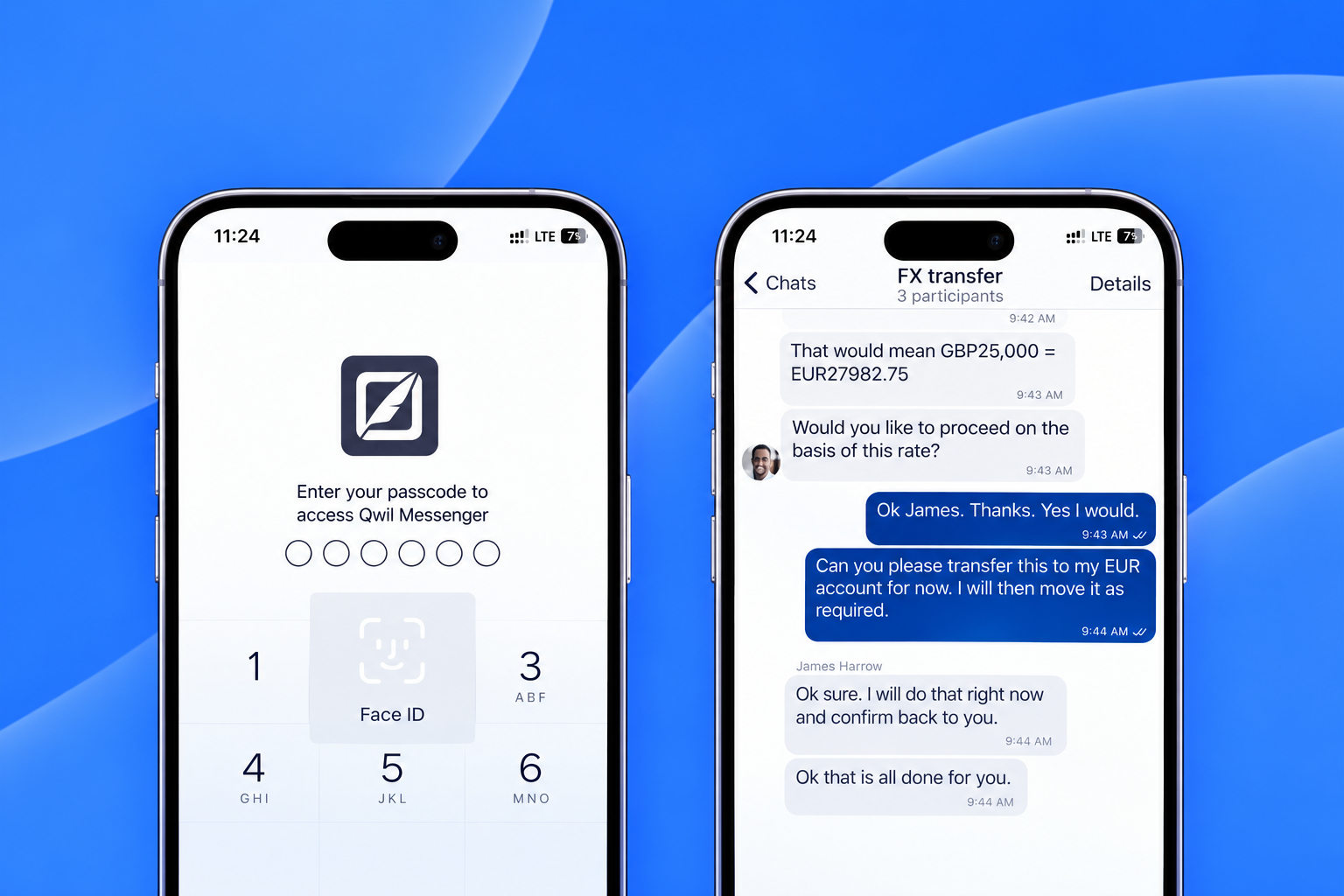
Today, Qwil brings together messaging, file sharing, e-signatures, video meetings, calendar functionality, and a complete interaction history. For businesses, this makes it possible to manage a substantial share of client communication in one environment while keeping it within the company’s own infrastructure. Qwil says its platform is used by more than 3,000 organizations.
In 2025, the company added a meeting scheduler, AI-generated summaries, document scanning, and video uploads. Later updates introduced improved AI summaries, pinned chats, announcements, client team settings, and fully self-service trial onboarding.
Another area of development is Qwil Connect. The company is building a model in which organizations, professionals, and their clients can interact within one secure environment while maintaining clear separation between individual corporate workspaces.
How Qwil Makes Money
Qwil’s business model is based on a monthly fee per employee at the corporate client.
The paying user is typically an employee who communicates with clients through Qwil, such as a relationship manager or financial adviser. End clients who receive messages, exchange documents, or interact with the organization through the platform do not pay separately for the service.
As a result, Qwil’s growth depends primarily on two metrics: the number of organizations using the platform and the number of paid seats within those organizations. Available materials do not disclose how many of the more than 3,000 organizations are recurring paying customers or the average number of paid seats per client.
Qwil Expands Its CRM Integrations
One of Qwil’s main priorities in 2026 has been expanding integrations with CRM systems and platforms used by financial advisers. The company already integrates with Salesforce, Wealthbox, Plannr, Intelliflo, Morningstar Wealthcraft, HubSpot, and Zoho, and has also added an integration with Time4Advice Curo. An update for Wealthcraft was released in May, followed by Curo in June.
In July, Qwil provided more detail on how its integrations with Intelliflo, Plannr, Wealthbox, and Salesforce work. The objective is to embed Qwil into advisers’ existing workflows: client messages and interaction history can be stored alongside the client profile in the CRM, reducing friction for employees and making the platform easier to adopt.
For Qwil, this can make deployment more straightforward. A firm can add secure communications to the CRM it already uses without forcing employees to rebuild their daily workflow. Qwil effectively becomes part of the client’s existing technology stack, while conversations and interaction history remain tied to the relevant CRM profile.
Qwil Expands in Canada
In 2026, Qwil increased its presence in Canada, particularly among financial advisers.
On May 5, the company expanded access to Canadian data residency using Amazon Web Services (AWS). The option had previously been available mainly to larger enterprise clients but was opened to a broader range of organizations.
For the Canadian market, Qwil lists pricing of C$35 per employee per month, with an unlimited number of end clients.
Local data residency is particularly important in financial services, where organizations face strict requirements around privacy, data storage, and the handling of client information.
Qwil also stepped up its content and market outreach in Canada. In June, the company published a series of articles aimed at financial advisers and other regulated industries, covering enterprise messaging, secure communications, and PHIPA, Ontario’s legislation governing the protection of personal health information.
This type of content supports Qwil’s efforts to reach decision-makers in its target industries and generate enterprise sales opportunities.
Another Growth Market: U.S. Healthcare
Financial services remains Qwil’s core market, but the company is also building its presence in healthcare.
In June, Qwil published material on secure patient communication in line with HIPAA, the U.S. law governing the protection of medical information. The company has also published content on regulatory compliance and secure communications for healthcare organizations.
The logic is similar to Qwil’s positioning in financial services. Banks, investment firms, and healthcare providers can face challenges when using consumer messaging apps for sensitive communications, particularly around data storage, message history, and internal compliance requirements. Qwil is positioning itself between the ease of use of mainstream messaging apps and the security and compliance requirements of regulated industries.
That is why financial services, wealth management, and healthcare remain the company’s primary target markets.
AI Becomes Part of the Product
Qwil is integrating AI into day-to-day client communication workflows. The company has developed AI-generated summaries designed to help users review conversation history and identify the key details of a client interaction more quickly. These features were updated several times in 2025, and further AI development remains on the product roadmap for 2026.
Qwil also participated in SPOTLIGHT: The AI Series by Verve, a webinar series for financial advisers and business leaders focused on practical applications of AI. The sessions showcase specific tools, include product demonstrations, and explore how AI can be used in financial advisory workflows.
AI features have become an important extension of Qwil’s core communications platform. They are intended to reduce manual work around client conversations and make the service more efficient for employees managing large volumes of client interactions every day.
What Qwil Clients Say
Public client feedback provides a useful view of how the platform is used in practice. In February 2025, Simon Bullock, founder of Mulberry Bow, gave Qwil a highly positive review and said the platform had become an important part of the firm’s client communications, from initial contact and onboarding to everyday messaging and secure document exchange.
Another example is Nedbank Private Wealth, an international private bank and wealth manager within South Africa’s Nedbank Group. Head of Client Services Tiago Ferreira highlighted the ease of rolling Qwil out at scale and the user experience for high-net-worth clients. Through the platform, clients can also submit trading instructions to the bank’s execution team.
There are examples outside financial services as well. Hopperround Travel & Cruises described Qwil as a way to bring several client communication channels together within a single application.

Qwil Financial Performance
In its latest available shareholder update, Qwil reported a significant increase in shareholders’ equity.
As of September 30, 2025, shareholders’ equity had increased to £1,585,066, up from £732,861 previously. That represents an increase of £852,205, or approximately 116.3%. Shareholders’ equity reflects the difference between a company’s assets and liabilities and provides a snapshot of its financial position at the reporting date.
Qwil continues to file its required financial statements in the UK on time. According to the shareholder update, the company has not issued new shares over the past two years, meaning existing shareholders did not experience additional dilution from new share issuance during that period.
Comparable revenue and ARR, or annual recurring revenue, figures for 2025–2026 have not yet been disclosed. The next financial updates should therefore provide a clearer view of how product development, new integrations, and geographic expansion are translating into commercial growth.
Focus on Organic Growth
Over the past six months, Qwil has not announced a major new funding round, an acquisition, or a sale of the business.
Based on the latest shareholder update, the company is currently prioritizing organic growth, enterprise sales, integrations, and expansion within its existing target markets.
That focus is also visible in Qwil’s public activity during 2026. Much of its content has centered on specific customer needs rather than major corporate events: HIPAA, PHIPA, enterprise messaging, CRM integrations, and the use of AI by financial advisers.
This fits Qwil’s B2B model, where sales cycles can be relatively long, particularly in regulated industries, and purchasing decisions depend heavily on security, integration capabilities, and regulatory compliance.
Key Risks
Qwil operates in a competitive enterprise communications market, where it competes with both specialized platforms and familiar tools such as email, SMS, WhatsApp, and larger enterprise software providers.
Another factor is Qwil’s reliance on third-party ecosystems. Salesforce, Wealthbox, Intelliflo, Plannr, and other platforms help Qwil become more deeply embedded in clients’ workflows, but part of the company’s growth also depends on the stability of those integrations and the strategic direction of its partners.
Qwil also remains a private company and publishes a relatively limited amount of financial information. Revenue, ARR, the number of paying organizations, customer retention, and cash flow have not been disclosed in the materials currently available.
That limits the ability to assess the company’s operating performance using the same metrics that investors would typically have for a public software business.

IPO, Sale of the Business and Investor Liquidity
Qwil remains privately held. In its latest update, the company said it had not issued additional shares over the past two years, but it did not provide new information on potential secondary sales by existing shareholders.
There are also no confirmed plans for an IPO, a sale to a strategic acquirer, or another formal liquidity program.
Over the longer term, potential liquidity scenarios could include an IPO or a sale of the company to a larger international technology group. At this stage, however, there is no confirmed timetable and no disclosed negotiations. The company has said it intends to update shareholders if such opportunities emerge.
What This Means for Qwil Investors
Through 2025 and 2026, Qwil continued to develop both its product and the infrastructure around it. The company expanded its CRM integrations, broadened access to Canadian data residency, continued developing AI features, and increased its focus on financial services and healthcare.
At the same time, its strategy remains measured: no major new funding rounds, M&A transactions, or announced IPO plans. The focus is currently on sales, integrations, and organic expansion within its chosen markets.
The next major data point for investors will be the company’s financial performance. The increase in shareholders’ equity and continued product development provide evidence of progress, while future financial updates should make it possible to assess more clearly how that progress is translating into the scale and economics of the business.
